🇵🇱 Handcrafted in Poland since 2014
It started in my brother's dining room.
In 2013 my brother ordered an ErgoDox through Massdrop. Before it arrived, I found the open-source PCB files and built ten of them myself: one for him, nine for people on Deskthority and Geekhack who wanted one too.
The first batch was hand-soldered with a plain stick iron, on his dining room table. So was every batch since. Better iron now, different table, nothing else has changed.
He helped at the start, then went back to his own work. I stayed.
Half a year later the company I worked for went under. I had no job, and I had ten keyboards behind me, so I registered a business and gave it a try. Nobody was doing this back then. A split ergonomic keyboard was something most people had never seen, and making them for a living sounded like a bad idea.
That was 2014. FalbaTech has been running ever since.
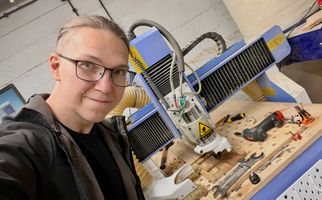
One person. One workshop. My hands on every keyboard.
My name is Jan, but most people call me Jasiek. I'm the owner of FalbaTech and I do everything here myself.
PCB design, CNC, lasers, firmware, soldering, wood finishing, packaging, repairs, and customer support - all of it goes through my hands.
The workshop is in Ciborz, about 300 meters off the main road. Forest on one side, cornfield on the other. The quiet helps you focus.
The FalbaTech Story
Watch an independent video by 3D-Info about how FalbaTech grew from a small workshop in Poland into a company shipping ergonomic keyboards worldwide.
Over half a million views on YouTube.
This video was created independently and was not commissioned or sponsored by FalbaTech.
My parent's basement.
For the first two years I worked out of my parents' basement.
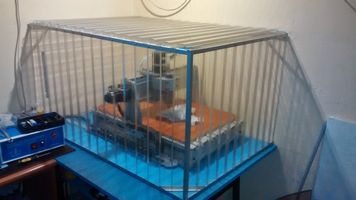
In 2014 the workshop was very simple - one CNC mill for aluminum and PVC, a blue steel workbench, and a homemade enclosure made of PVC strips. Early on I was making mostly PVC cases.
The mill kept breaking down, and I kept fixing it.
Soon after, the first 40W CO₂ laser joined the workshop. That one was a real disaster - constant failures, mirror alignment, power supply and cooling issues. Some weeks I spent more time on repairs than on actual work.
In spite of all that, the first proper batches of keyboards started coming out of that basement.
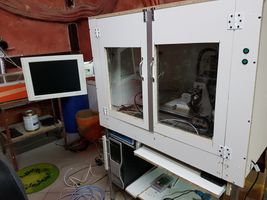
Better setup, same walls.
In 2015 I upgraded the basement workstation. The mill got its own plywood enclosure, a Dell tower joined the bench, plus an LCD monitor. The red basement walls didn't change. Neither did the kiwi-print floor mat.
That was also when I started working with wood at scale. PVC had felt simpler and more predictable at first, but over time the amount of waste, the dust, and how hard it was to recycle started to bother me. Wood turned out to be more natural, more durable, and a much better fit for the ergonomic keyboards I wanted to make.
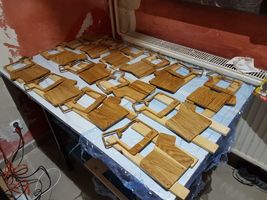
The moment it stopped being a hobby.
In 2017 the first proper batch came out of the workshop - 23 wooden keyboard cases drying at the same time, on a single table.
That's when I realized people actually wanted these keyboards.
Rented unit - one fire and two water damage incidents.
In parallel, starting in 2015, I rented a small unit in Lidzbark - in a former discotheque that had since been turned into a fruit wholesale warehouse. Some of the heavier work moved there; some of it stayed in the basement.
I had to give up on that place eventually. There was one fire (something fairly common when you're machining wood with CNC) and two floods. By 2018 I'd had enough - I bought my own pavilion.
The moment it stopped being a hobby.
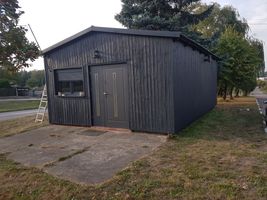
My first own workshop.
In 2018 I bought a wooden pavilion - on a loan. Black timber boards, a single module, and the first workshop that belonged entirely to FalbaTech.
Keyboards kept shipping.
Moving to the countryside.
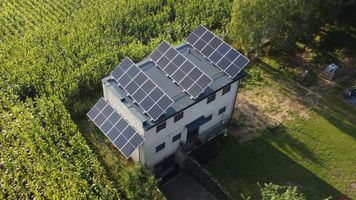
In 2021, during the pandemic, I moved the workshop out of the city and into the countryside.
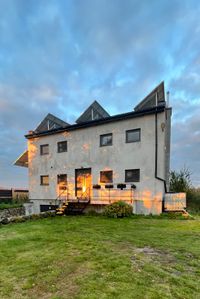
That's when the current workshop in Ciborz came together - its own building, CNC mills, lasers, 3D printers, solar panels, a deep well, and an on-site biological wastewater treatment system.
One basement. Four locations. One fire. Three water damage incidents. Twelve years of work. Still here.
No Kickstarter. No investors.
Most keyboard brands started with a Kickstarter or a big crowdfunding round.
FalbaTech didn't.
Every machine in this workshop was bought by my customers and fans - one keyboard at a time, over twelve years. Every złoty from every sale went straight back into the workshop: better machines, more tools, my own building. No crowdfunding, no investors, no corporation, no board.
That means nobody decides for me:
* which products to discontinue,
* which models to stop supporting,
* how much to cut quality,
or how much to raise prices.
I answer to my customers, full stop. That's only fair - they're the ones who built this workshop.
It's also why a keyboard built in 2014 can come back here for repair in 2026.
Several thousand keyboards later.
Over twelve years I've built and shipped several thousand keyboards to customers all over the world.
North America, Europe, Asia, Australia - sometimes places I had to look up on a map first.
A lot of customers come back years later for another keyboard. Honestly - these keyboards rarely break.
That makes running the business harder than it might sound, but that's how good tools should be built.
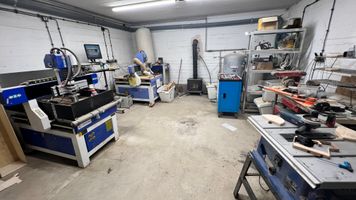
Moving to the countryside.
What's in the workshop.
CNC and lasers
100W CO₂ laser
20W fiber laser
90×60 CNC mill for wood and plastics
90×60 CNC mill for aluminum
2× Bambu Lab A1 Combo
Rotrics robotic arm
Wood and electronics
Table saw
Drill press
Hand router
Soldering benches
Keyboard assembly station
Wood finishing station
Sewing and the rest
Elna 664 Pro overlock
4-thread overlock
Cricut Maker
Sublimation press
58 mm button press
A machine that makes 3D-printer filament out of PET bottles
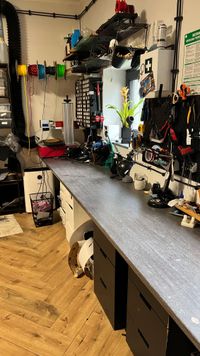
Everything is made here.
Everything is made here.
Every keyboard, case, plate, wrist rest, and accessory in the FalbaTech catalog is made in this workshop.
No outsourcing. No “designed in Poland, manufactured elsewhere” small print.
This workshop has flooded once, too. I rebuilt it.
Keyboards kept shipping.
⸻
Built for independence, step by step.
Solar panels on the roof generate part of the energy used by the CNC mills, lasers, and 3D printers. Full off-grid operation is the goal, but in Poland, winter sunlight makes that a real challenge.
In winter, the workshop is heated by a wood-burning stove, fed with offcuts and scraps from production.
Water comes from our own deep well on the property. Wastewater goes through an on-site biological treatment system. No municipal water supply. No municipal drain.
We also have a homemade PET recycling line. Today, we use it less often because more bottles return through the deposit system, but when the material is available, we can turn it into 3D printing filament and use it for workshop-made accessories.
Whatever cannot become a product comes back to the workshop as energy. Whatever leaves the workshop, leaves with purpose.
Lifetime repair.
I repair every keyboard I've ever built.
It doesn't matter whether it was made in 2013 or 2026. Wired or wireless. QMK or ZMK.
If it came out of this workshop - it can be repaired here.
You only pay for parts and shipping. The work itself is on me.
It's not a marketing strategy. It's just how I run FalbaTech.
⸻
Polish company. Polish workshop. Polish taxes.
FalbaTech is a registered Polish business - every order comes with a receipt or VAT invoice. A large share of every keyboard's price goes back into materials, machines, energy, shipping, and the taxes that keep a small manufacturing workshop running in Europe.
⸻
Get in touch.
📧 contact@falba.tech 📍 Ciborz, Poland, 13-230 🛠 Workshop hours: whenever the lights are on
11 years. One pair of hands. Thousands of keyboards.
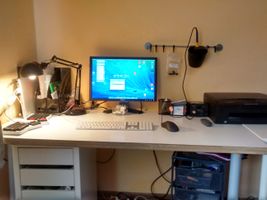
Where it all started. A desk in a rented room. 2014.
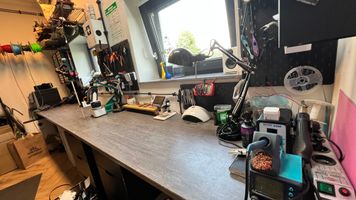
Where keyboards are born. Every joint soldered by hand.
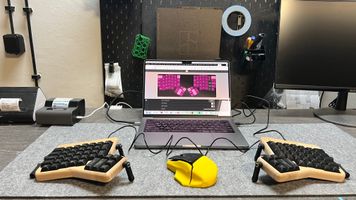
Where ideas become layouts. Designing and testing every build personally.
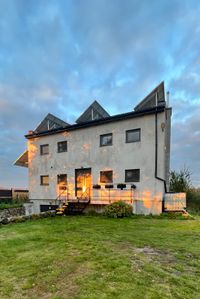
FalbaTech HQ. Solar powered, northern Poland. This is where your keyboard comes from.